What "I'll send the notes" really costs
The notes you send the day after a meeting do not just arrive late. They are no longer accurate, and less so with every hour.
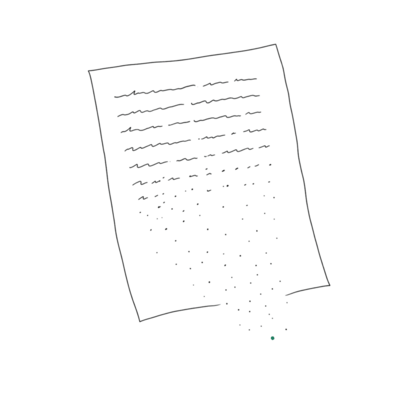
On the way out you say it again. "I'll send the notes." Everyone nods, the call ends, and for the others the meeting is over. For you it has only moved.
Right now the meeting is as clear in your head as it will ever be. From here on, the memory only thins.
So the notes go on the list, behind the next call, behind the reply you still owe, behind the thing that broke over lunch. They go out tonight, or tomorrow, or they shrink to three lines that leave out the part that counted. While they wait, your memory does not wait with them. It is already going.
The curve
This forgetting has a shape. Hermann Ebbinghaus measured it in the 1880s. He memorised nonsense syllables and tested himself hour after hour. Recall does not fade evenly. It drops most steeply right after learning and then flattens. This forgetting curve has held for over a hundred years.
Lay your meeting on this curve. When the call ends, you are at the top and hold almost all of it. Then the curve falls, and it falls most steeply in the hours when you have the least time to write anything down.
The meeting ends and you are already half in the next one. No moment to write, only the next call. By evening three more conversations sit in between, and the decision that was clear at 10:15 is now one of forty things.
The notes go out the next morning. By then the curve is long flat. You write from the remnant that survived, not from the hour itself. Every hour of delay costs you details that do not come back.
What leaks out
The decision is not what goes first. The reason behind it is.
That the team chose the second option, that you still know. It is short, and it changed the plan. What fades is the why. The reservation someone raised, the condition on the yes, the one objection everyone set aside for now. By the time you write it up, only the decision is left, without the thinking behind it. Next month someone asks why, the answer is not in the notes, and the question comes up again.
You cannot solve this with more effort. You are fighting the curve, and the curve wins.
It is the same with the action items. You keep the big one. The two smaller asks, the favour someone offered, the thing you meant to look up, sit in the part the curve has already eaten. Nobody takes them on, because nobody wrote them down. A week later the handoff is missing.
The fix is not a better memory. It is an earlier record, one that is there before the forgetting starts.
Flatten the curve
That is why readme captures from minute zero. readme works from the recording itself. The transcript, the decisions, the action items with their owners, and who said what are there while the meeting is still fresh. There is nothing to reconstruct later, because nothing was lost.
Put that second line on the chart. It does not fall. It runs flat across the top, all day, because the record was made while the memory was still complete. The forgetting never even starts. The notes were never a promise for later. They were done before the room was empty.
You have invested the hour anyway. Let your next meeting record itself while you are still in it.
Try it with your next meeting.
You get a clear summary with every decision and every task. And plenty more.
Try for free